
2026 Deer Collision Season: What Truck Fleets Need to Know
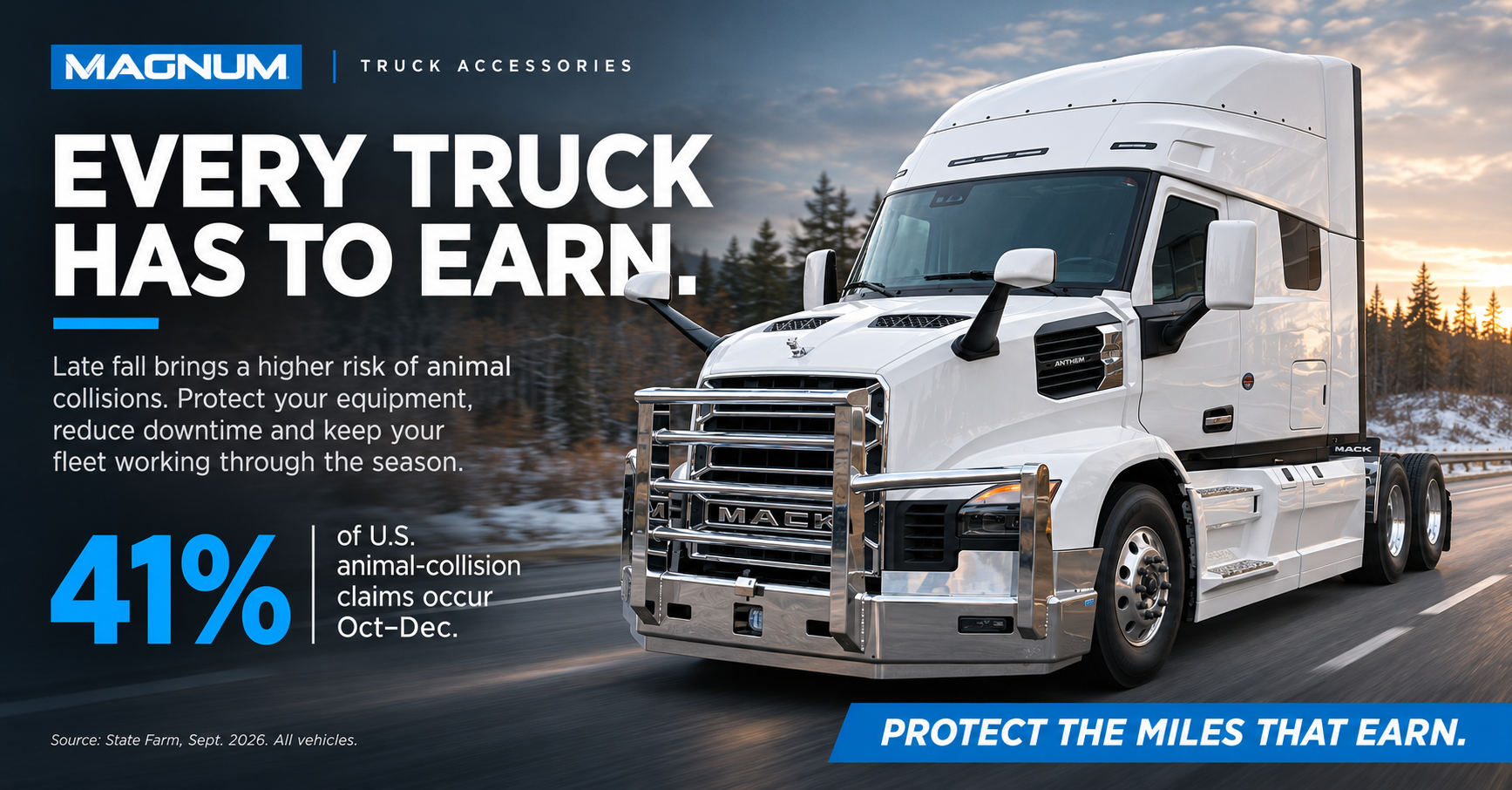
Deer collision season brings additional challenges for commercial trucking fleets across North America. While deliveries must stay on schedule, the risk of wildlife encounters increases during the fall months in many regions. For fleet operators, preparing for deer collision season means understanding regional collision risks, keeping drivers informed, and evaluating the equipment that helps protect their trucks. With November identified as the peak month for large-animal collisions in the United States, preparation becomes especially relevant.
New data from State Farm’s September 2026 animal-collision analysis puts the issue in perspective. The insurer estimates that more than 1.6 million animal-vehicle collision claims occurred across the United States between July 1, 2025 and June 30, 2026. National odds improved from approximately 1 in 139 in the previous study period to 1 in 145, but late fall remains an especially important time to stay alert.
For fleet managers and owner-operators, the practical question is not whether wildlife encounters can be eliminated. It is how to prepare trucks, drivers and routes for predictable seasonal exposure.
Deer Collision Season 2026: Which States Face the Greatest Risk?
Wildlife collision risk varies significantly across the United States. State Farm’s September 2026 analysis highlights differences between states such as Wisconsin, Mississippi, Texas, and Utah. Understanding these regional patterns helps fleet managers make more informed decisions about driver awareness, route planning, and vehicle protection.
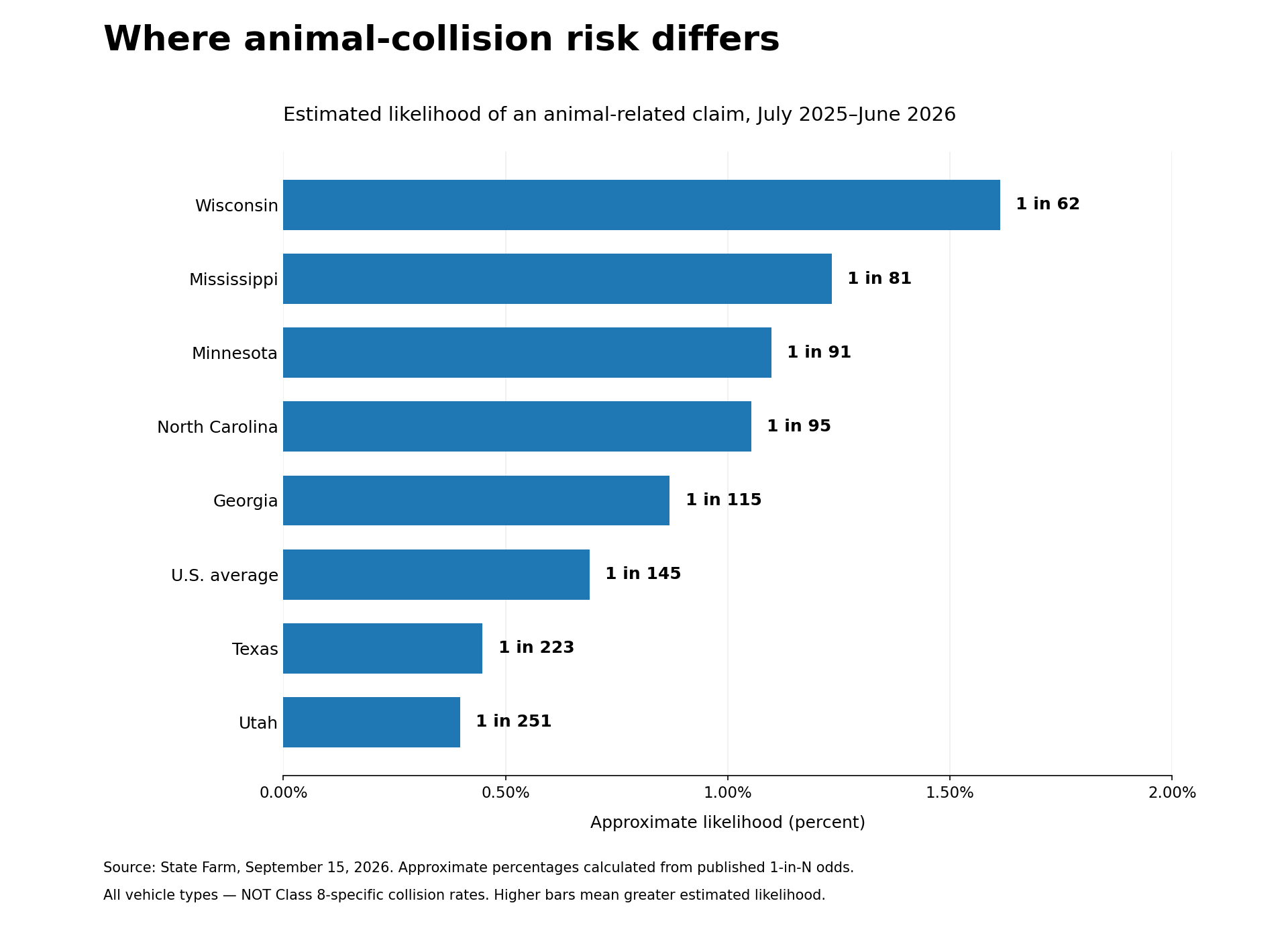
The following chart compares estimated annual animal-vehicle collision likelihoods across selected states. These figures cover all vehicle types, not exclusively commercial trucks.
2026 animal-collision statistics: three numbers worth knowing
- More than 1.6 million: estimated U.S. animal-vehicle collision claims in State Farm’s July 2025–June 2026 analysis.
- 1 in 145: estimated annual U.S. likelihood of an animal-involved claim across drivers and vehicle types.
- November: the highest-risk month for large-animal collisions, followed by October and December, according to the 2026 analysis.
Important context: these figures cover the wider U.S. vehicle population. They do not represent a measured collision rate specifically for Class 8 trucks or Magnum-equipped vehicles.
Where are animal collisions most likely?
The national average does not capture how much conditions vary by state. In the 2025–26 State Farm estimates, Wisconsin had odds of approximately 1 in 62, Minnesota 1 in 91 and Mississippi 1 in 81. Meanwhile, Texas was estimated at 1 in 223 and Utah at 1 in 251.
Chart: Selected states and the U.S. average, based on State Farm’s published 2025–26 odds. The bars convert 1-in-N odds into approximate percentages for visual comparison; all vehicle types, not a commercial-truck-only dataset. View the primary source and full state rankings.
These differences are useful planning context, but they are not a prediction for an individual fleet. Commercial routes, driving hours, vehicle types, local wildlife corridors and other exposure factors matter. A Texas operation running high-mileage rural routes should not dismiss its exposure simply because the state’s estimated population-wide odds are below the U.S. average.
What should fleets review before peak deer season?
1. Prepare drivers for the conditions
State Farm recommends additional attention in wildlife-crossing areas, especially from dusk through dawn. Appropriate speed, visibility and braking technique remain important. If an animal suddenly enters the road, drivers should prioritize maintaining control and follow their training and applicable safety procedures rather than swerving unpredictably.
2. Consider the complete front-end specification
Fleet front-end equipment decisions should account for the truck make, model and year, guard mounting design, headlamp access, routine service access, towing provisions and compatibility with applicable collision-mitigation systems. Those details are worth reviewing with the equipment manufacturer and dealer before an installation is approved.
Magnum offers front-end protection for heavy-duty trucks, including vehicle-specific products for Mack Anthem models. Product specifications and supported configurations vary, so fleets should verify fitment and options for each truck.
3. Plan what happens after a wildlife strike
A guard does not prevent wildlife from entering the roadway, and no front-end protection system can guarantee that a vehicle will remain operable after an impact. Following a collision, the priority is driver safety, securing the scene, reporting as required and inspecting the vehicle before further operation. A fleet should document repairs, parts, time out of service and related costs so future equipment decisions can draw on its own experience.
Protect the work behind every mile
Every truck on the road supports commitments beyond the cab: customers, delivery schedules, drivers, maintenance teams and businesses. That is why seasonal risk awareness belongs in the same conversation as equipment specification and operating readiness.
Magnum builds front-end protection for trucks that earn a living. To explore guards for your specific make and model, find a Magnum dealer or browse our front-end protection lineup.
Frequently asked questions
When is animal-collision risk highest in the United States?
State Farm’s September 2026 analysis identifies November as the peak month for large-animal collisions, followed by October and December.
Does the 1-in-145 animal-collision statistic apply specifically to commercial trucks?
No. It is a U.S. population-wide estimate, not a truck-only or fleet-specific rate. Individual fleet exposure depends on its routes, annual mileage, timing and operating conditions.
Can a grille guard prevent deer collisions or guarantee that a truck stays on the road?
No. A guard is front-end protection equipment, not a collision-avoidance system. Impact outcomes vary with vehicle configuration, collision conditions and guard design. Always inspect the truck after a strike and follow appropriate safety procedures.
Data sources: State Farm newsroom, September 15, 2026; State Farm state-level odds and seasonal guidance, September 15, 2026. Data cover animal-related claims across vehicle types, not Magnum performance or Class 8 trucks exclusively.